
Análisis a fondo de los chips LED de alta potencia: parámetros, rendimiento y estructura interna

Incluso hoy en día, muchos conductores experimentados todavía creen firmemente que los faros halógenos son los mejores faros. Esta mentalidad es similar a cómo algunas personas todavía piensan que el antiguo iPhone 4 fue el mejor teléfono jamás fabricado.
Parte de eso proviene de los recuerdos del diseño y la época, parte de la nostalgia, y parte del hecho de que los faros halógenos eran, en muchos sentidos, en realidad no estaban nada mal. Para entender por qué, necesitamos mirar la historia, la experiencia de conducción y la tecnología.
1. Chips LED de alta potencia: una descripción general
Los chips LED de alta potencia se han convertido en la piedra angular de las soluciones de iluminación modernas, ofreciendo ventajas significativas en eficiencia energética, vida útil e impacto ambiental en comparación con las tecnologías de iluminación tradicionales como el halógeno.
2. Qué son los "chips LED de alta potencia" y sus ventajas
2.1 Definición y clasificación
Los chips LED de alta potencia suelen referirse a fuentes de luz LED con una corriente nominal superior a 100 mA y una potencia de 1 W o superior. Comúnmente disponibles en el mercado son LED individuales de 1 W, 3 W y 5 W, así como fuentes de luz COB (Chip-on-Board), con una potencia que a menudo alcanza decenas o incluso cientos de vatios. Dependiendo de la potencia y el embalaje, se pueden utilizar en varios escenarios, desde focos domésticos hasta grandes lámparas industriales y mineras y farolas.
2.2 Principio de funcionamiento
El proceso de emisión de luz de un LED implica que la corriente pasa a través de un chip semiconductor, donde los electrones y los huecos se recombinan y liberan energía en forma de fotones. Este proceso es altamente eficiente, convirtiendo la energía eléctrica en energía luminosa a una velocidad mucho mayor que las lámparas incandescentes o fluorescentes tradicionales, al tiempo que genera menos calor, lo que resulta en una vida útil más larga.
2.3 Ventajas de los chips LED de alta potencia
- Eficiencia energética: Se convierte más energía eléctrica en energía luminosa en lugar de energía térmica, lo que resulta en un consumo de energía significativamente menor que las lámparas incandescentes.
- Larga vida útil: Los chips LED tienen una vida útil que supera con creces la de las bombillas tradicionales, capaces de emitir luz continuamente durante miles a decenas de miles de horas.
- Respetuosos con el medio ambiente y seguros: No contienen sustancias nocivas como el mercurio, generan poco calor y reducen los riesgos de seguridad.
- Color de luz flexible: A través de diferentes diseños de chip, fósforo y encapsulado, se pueden lograr varias temperaturas de color y colores de luz para adaptarse a diferentes escenarios de aplicación.
3. Entendiendo la "hoja de especificaciones": cómo leer el "documento de identidad" de un chip LED
3.1 Parámetros clave
- Potencia (W) y flujo luminoso (lm): La potencia refleja el consumo de energía, mientras que el flujo luminoso refleja el brillo. Los LED de alta calidad emiten un alto brillo incluso con baja potencia.
- Temperatura de color (K) e índice de reproducción cromática (CRI): La temperatura de color determina el "tono" de la luz, y el CRI mide la precisión de la reproducción del color.
- Ángulo de emisión y eficacia luminosa: El ángulo de emisión afecta la distribución de la luz, mientras que la eficacia luminosa (lm/W) es un indicador importante del rendimiento de ahorro de energía.
4. Estructura interna y materiales clave de los chips LED
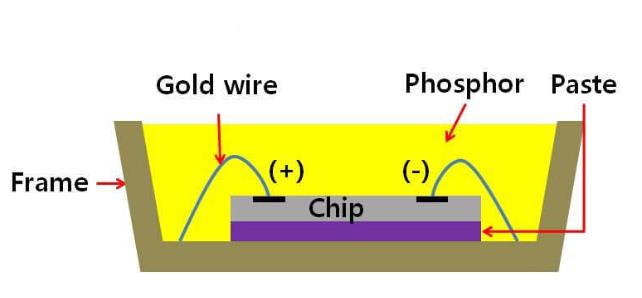
La estructura interna de los chips LED de alta potencia consta de múltiples componentes de precisión que afectan directamente el rendimiento y la vida útil:
- Chip LED: El elemento central emisor de luz que determina el brillo, la eficiencia y la vida útil.
- Hilo de oro + unión de soldadura + marco: Los hilos de oro sirven como vías conductoras y de conducción de calor. Las uniones de soldadura deben ser completas y lisas. Los marcos suelen estar hechos de cobre o aluminio para una buena conducción del calor.
- Fósforo: Los LED blancos utilizan un chip azul y fósforo amarillo. La formulación del fósforo y el proceso de recubrimiento afectan la consistencia del color y la reproducción del color.
- Encapsulado (lente/resina): El encapsulado protege la estructura interna e influye en la eficiencia de emisión de luz, el ángulo del haz y la disipación de calor.
- Sustrato/Disipación de calor: El sustrato es responsable de disipar el calor para evitar que el chip se sobrecaliente, asegurando la longevidad y el rendimiento.
5. ¿Por qué los LED se atenúan o tienen una vida útil acortada?
Los chips LED pueden experimentar atenuación o una vida útil acortada debido a los siguientes factores:
- Envejecimiento del chip: Las altas temperaturas hacen que la eficiencia del chip LED disminuya con el tiempo.
- Envejecimiento del fósforo: La eficiencia del fósforo disminuye bajo una exposición prolongada a altas temperaturas, lo que lleva a una reducción del brillo.
- Envejecimiento del material de encapsulación: Los materiales de encapsulación pueden degradarse debido al calor, reduciendo la transmitancia de la luz.
- Mala disipación de calor: Un diseño inadecuado de disipación de calor conduce a la acumulación de calor, lo que acorta la vida útil.
6. Métodos de cableado: serie vs. paralelo – Comparación de ventajas y desventajas
6.1 Conexión en serie
- Múltiples chips LED conectados de extremo a extremo. El voltaje total es la suma de los chips individuales.
- Ventajas: Requiere solo una fuente de alimentación de corriente constante.
- Desventajas: Si un chip falla, toda la conexión en serie dejará de funcionar.
6.2 Conexión en paralelo
- Todos los terminales positivos están conectados entre sí, y todos los terminales negativos también están conectados entre sí.
- Ventajas: El fallo de un chip no afecta a los demás.
- Desventajas: Requiere una alta consistencia de los chips, ya que pequeñas diferencias pueden conducir a una distribución desigual de la corriente y a una vida útil reducida.
7. Cómo evaluar la calidad de los chips LED: de la apariencia a las pruebas de rendimiento
7.1 Inspección visual
- Tamaño del chip: Los chips más grandes generalmente indican una mejor disipación de calor.
- Hilo de oro: Los hilos de oro deben ser gruesos y claros, sin roturas ni impurezas.
- Soldadura: Las uniones de soldadura deben ser lisas y completas, sin soldaduras frías o deficientes.
- Adhesivo de encapsulado/lente: El encapsulante o la lente deben ser claros y transparentes, libres de burbujas e impurezas.
7.2 Pruebas de rendimiento
- Punto de luz: Compruebe la uniformidad y claridad del punto de luz.
- Consistencia del color: Compruebe si hay diferencias de color significativas entre varios LED.
- Detección de parpadeo: Utilice la cámara de un teléfono móvil para comprobar si hay parpadeo, lo que indica problemas con la fuente de alimentación o el LED.
8. Elegir el LED correcto: comprender los detalles clave para evitar trampas de calidad
Los chips LED de alta potencia pueden parecer complejos, pero centrarse en factores como la eficacia luminosa (lm/W), la temperatura de color, el CRI, la disipación de calor y el diseño del encapsulado le ayudará a seleccionar un chip LED de alta calidad y duradero.